 Add to Chrome
 Add to Firefox
 Add to Edge
A Heterogeneous Architecture for Robot RL Beyond GPU-Dominant Paradigms
May 28, 2026
Simulation-based RL for contemporary robot control is increasingly organized around GPU-resident simulation: physics, rollout collection, and learning are placed on a single GPU-centric execution path. This paradigm has greatly improved training speed, but it has also encouraged a default assumption that efficient training requires physics to reside on the GPU. We revisit this assumption. Our view is that, in simulation-dominated robot control, the essential question is not which processor runs physics, but whether simulation throughput, policy learning, and runtime synchronization form an efficient end-to-end loop. We present UniLab, a heterogeneous CPU-simulation / GPU-learning architecture that decouples CPU-parallel simulation from GPU policy updates through a unified runtime for data movement, buffering, and synchronization. UniLab is implemented as a complete and extensible training system using MuJoCoUni and MotrixSim CPU-batched physics backends, supporting PPO, SAC, FlashSAC, TD3, and APPO. On representative simulation-based robot control tasks, UniLab improves end-to-end training efficiency by 3--10$\times$ under the same hardware configuration, while reducing dependence on the NVIDIA CUDA-based software stack and supporting cross-platform execution on the Apple macOS platform and the AMD ROCm and Intel XPU accelerator backends. These results show that GPU simulation is an effective path to efficient training, but not a necessary one, broadening the practical system choices available for robot RL training. Project page: https://github.com/unilabsim/UniLab.

MuJoCoUni:Persistent Batched Runtime Primitives for MuJoCo
May 24, 2026We present MuJoCoUni, a downstream MuJoCo distribution for online robot learning and batched physics evaluation. Alongside the open-loop batched trajectory generation already provided by upstream mujoco.rollout, MuJoCoUni supplies runtime primitives for stateful environment execution. The target workloads need high-throughput parallel execution while retaining upstream CPU MuJoCo semantics for models, sensors, contact, and constraints. Its core object, BatchEnvPool, is a C++/pybind11 executor that owns per-environment mjModel copies, per-thread mjData workers, and an internal thread pool. It provides final-state-only short stepping, sparse reset, reset-lifecycle domain randomization, batched sensor forward evaluation without advancing dynamics, and batched Jacobian and height-field queries. The implementation is confined to the Python binding layer; MuJoCo's solver, contact model, integrator, and core source tree retain upstream semantics. This report describes the BatchEnvPool API, implementation boundary, relationship to rollout, and the validation and benchmark scripts shipped with the open-source mujoco-uni package, which is installed with \texttt{pip install mujoco-uni}.
GS-Playground: A High-Throughput Photorealistic Simulator for Vision-Informed Robot Learning
Apr 28, 2026Embodied AI research is undergoing a shift toward vision-centric perceptual paradigms. While massively parallel simulators have catalyzed breakthroughs in proprioception-based locomotion, their potential remains largely untapped for vision-informed tasks due to the prohibitive computational overhead of large-scale photorealistic rendering. Furthermore, the creation of simulation-ready 3D assets heavily relies on labor-intensive manual modeling, while the significant sim-to-real physical gap hinders the transfer of contact-rich manipulation policies. To address these bottlenecks, we propose GS-Playground, a multi-modal simulation framework designed to accelerate end-to-end perceptual learning. We develop a novel high-performance parallel physics engine, specifically designed to integrate with a batch 3D Gaussian Splatting (3DGS) rendering pipeline to ensure high-fidelity synchronization. Our system achieves a breakthrough throughput of 10^4 FPS at 640x480 resolution, significantly lowering the barrier for large-scale visual RL. Additionally, we introduce an automated Real2Sim workflow that reconstructs photorealistic, physically consistent, and memory-efficient environments, streamlining the generation of complex simulation-ready scenes. Extensive experiments on locomotion, navigation, and manipulation demonstrate that GS-Playground effectively bridges the perceptual and physical gaps across diverse embodied tasks. Project homepage: https://gsplayground.github.io.
Omni-Manip: Beyond-FOV Large-Workspace Humanoid Manipulation with Omnidirectional 3D Perception
Mar 05, 2026The deployment of humanoid robots for dexterous manipulation in unstructured environments remains challenging due to perceptual limitations that constrain the effective workspace. In scenarios where physical constraints prevent the robot from repositioning itself, maintaining omnidirectional awareness becomes far more critical than color or semantic information. While recent advances in visuomotor policy learning have improved manipulation capabilities, conventional RGB-D solutions suffer from narrow fields of view (FOV) and self-occlusion, requiring frequent base movements that introduce motion uncertainty and safety risks. Existing approaches to expanding perception, including active vision systems and third-view cameras, introduce mechanical complexity, calibration dependencies, and latency that hinder reliable real-time performance. In this work, We propose Omni-Manip, an end-to-end LiDAR-driven 3D visuomotor policy that enables robust manipulation in large workspaces. Our method processes panoramic point clouds through a Time-Aware Attention Pooling mechanism, efficiently encoding sparse 3D data while capturing temporal dependencies. This 360° perception allows the robot to interact with objects across wide areas without frequent repositioning. To support policy learning, we develop a whole-body teleoperation system for efficient data collection on full-body coordination. Extensive experiments in simulation and real-world environments show that Omni-Manip achieves robust performance in large-workspace and cluttered scenarios, outperforming baselines that rely on egocentric depth cameras.
HiWET: Hierarchical World-Frame End-Effector Tracking for Long-Horizon Humanoid Loco-Manipulation
Feb 06, 2026Humanoid loco-manipulation requires executing precise manipulation tasks while maintaining dynamic stability amid base motion and impacts. Existing approaches typically formulate commands in body-centric frames, fail to inherently correct cumulative world-frame drift induced by legged locomotion. We reformulate the problem as world-frame end-effector tracking and propose HiWET, a hierarchical reinforcement learning framework that decouples global reasoning from dynamic execution. The high-level policy generates subgoals that jointly optimize end-effector accuracy and base positioning in the world frame, while the low-level policy executes these commands under stability constraints. We introduce a Kinematic Manifold Prior (KMP) that embeds the manipulation manifold into the action space via residual learning, reducing exploration dimensionality and mitigating kinematically invalid behaviors. Extensive simulation and ablation studies demonstrate that HiWET achieves precise and stable end-effector tracking in long-horizon world-frame tasks. We validate zero-shot sim-to-real transfer of the low-level policy on a physical humanoid, demonstrating stable locomotion under diverse manipulation commands. These results indicate that explicit world-frame reasoning combined with hierarchical control provides an effective and scalable solution for long-horizon humanoid loco-manipulation.
DISCOVERSE: Efficient Robot Simulation in Complex High-Fidelity Environments
Jul 29, 2025We present the first unified, modular, open-source 3DGS-based simulation framework for Real2Sim2Real robot learning. It features a holistic Real2Sim pipeline that synthesizes hyper-realistic geometry and appearance of complex real-world scenarios, paving the way for analyzing and bridging the Sim2Real gap. Powered by Gaussian Splatting and MuJoCo, Discoverse enables massively parallel simulation of multiple sensor modalities and accurate physics, with inclusive supports for existing 3D assets, robot models, and ROS plugins, empowering large-scale robot learning and complex robotic benchmarks. Through extensive experiments on imitation learning, Discoverse demonstrates state-of-the-art zero-shot Sim2Real transfer performance compared to existing simulators. For code and demos: https://air-discoverse.github.io/.
Omni-Perception: Omnidirectional Collision Avoidance for Legged Locomotion in Dynamic Environments
May 25, 2025Agile locomotion in complex 3D environments requires robust spatial awareness to safely avoid diverse obstacles such as aerial clutter, uneven terrain, and dynamic agents. Depth-based perception approaches often struggle with sensor noise, lighting variability, computational overhead from intermediate representations (e.g., elevation maps), and difficulties with non-planar obstacles, limiting performance in unstructured environments. In contrast, direct integration of LiDAR sensing into end-to-end learning for legged locomotion remains underexplored. We propose Omni-Perception, an end-to-end locomotion policy that achieves 3D spatial awareness and omnidirectional collision avoidance by directly processing raw LiDAR point clouds. At its core is PD-RiskNet (Proximal-Distal Risk-Aware Hierarchical Network), a novel perception module that interprets spatio-temporal LiDAR data for environmental risk assessment. To facilitate efficient policy learning, we develop a high-fidelity LiDAR simulation toolkit with realistic noise modeling and fast raycasting, compatible with platforms such as Isaac Gym, Genesis, and MuJoCo, enabling scalable training and effective sim-to-real transfer. Learning reactive control policies directly from raw LiDAR data enables the robot to navigate complex environments with static and dynamic obstacles more robustly than approaches relying on intermediate maps or limited sensing. We validate Omni-Perception through real-world experiments and extensive simulation, demonstrating strong omnidirectional avoidance capabilities and superior locomotion performance in highly dynamic environments. We will open-source our code and models.
An Real-Sim-Real (RSR) Loop Framework for Generalizable Robotic Policy Transfer with Differentiable Simulation
Mar 13, 2025The sim-to-real gap remains a critical challenge in robotics, hindering the deployment of algorithms trained in simulation to real-world systems. This paper introduces a novel Real-Sim-Real (RSR) loop framework leveraging differentiable simulation to address this gap by iteratively refining simulation parameters, aligning them with real-world conditions, and enabling robust and efficient policy transfer. A key contribution of our work is the design of an informative cost function that encourages the collection of diverse and representative real-world data, minimizing bias and maximizing the utility of each data point for simulation refinement. This cost function integrates seamlessly into existing reinforcement learning algorithms (e.g., PPO, SAC) and ensures a balanced exploration of critical regions in the real domain. Furthermore, our approach is implemented on the versatile Mujoco MJX platform, and our framework is compatible with a wide range of robotic systems. Experimental results on several robotic manipulation tasks demonstrate that our method significantly reduces the sim-to-real gap, achieving high task performance and generalizability across diverse scenarios of both explicit and implicit environmental uncertainties.
Arm-Constrained Curriculum Learning for Loco-Manipulation of the Wheel-Legged Robot
Mar 28, 2024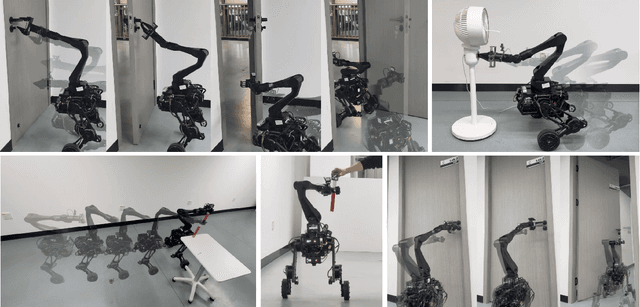
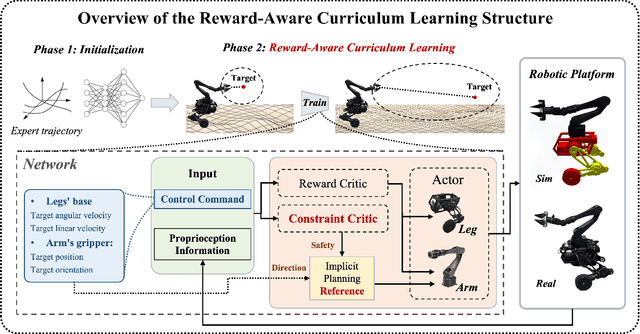
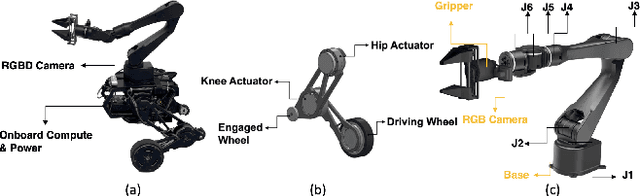
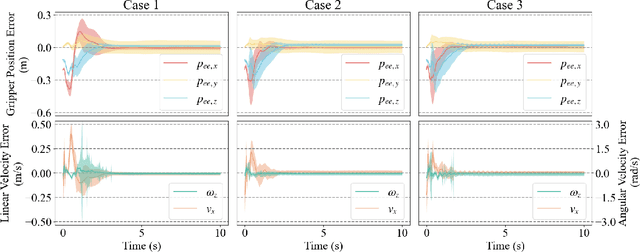
Incorporating a robotic manipulator into a wheel-legged robot enhances its agility and expands its potential for practical applications. However, the presence of potential instability and uncertainties presents additional challenges for control objectives. In this paper, we introduce an arm-constrained curriculum learning architecture to tackle the issues introduced by adding the manipulator. Firstly, we develop an arm-constrained reinforcement learning algorithm to ensure safety and stability in control performance. Additionally, to address discrepancies in reward settings between the arm and the base, we propose a reward-aware curriculum learning method. The policy is first trained in Isaac gym and transferred to the physical robot to do dynamic grasping tasks, including the door-opening task, fan-twitching task and the relay-baton-picking and following task. The results demonstrate that our proposed approach effectively controls the arm-equipped wheel-legged robot to master dynamic grasping skills, allowing it to chase and catch a moving object while in motion. Please refer to our website (https://acodedog.github.io/wheel-legged-loco-manipulation) for the code and supplemental videos.